D.C.U Services Ltd home
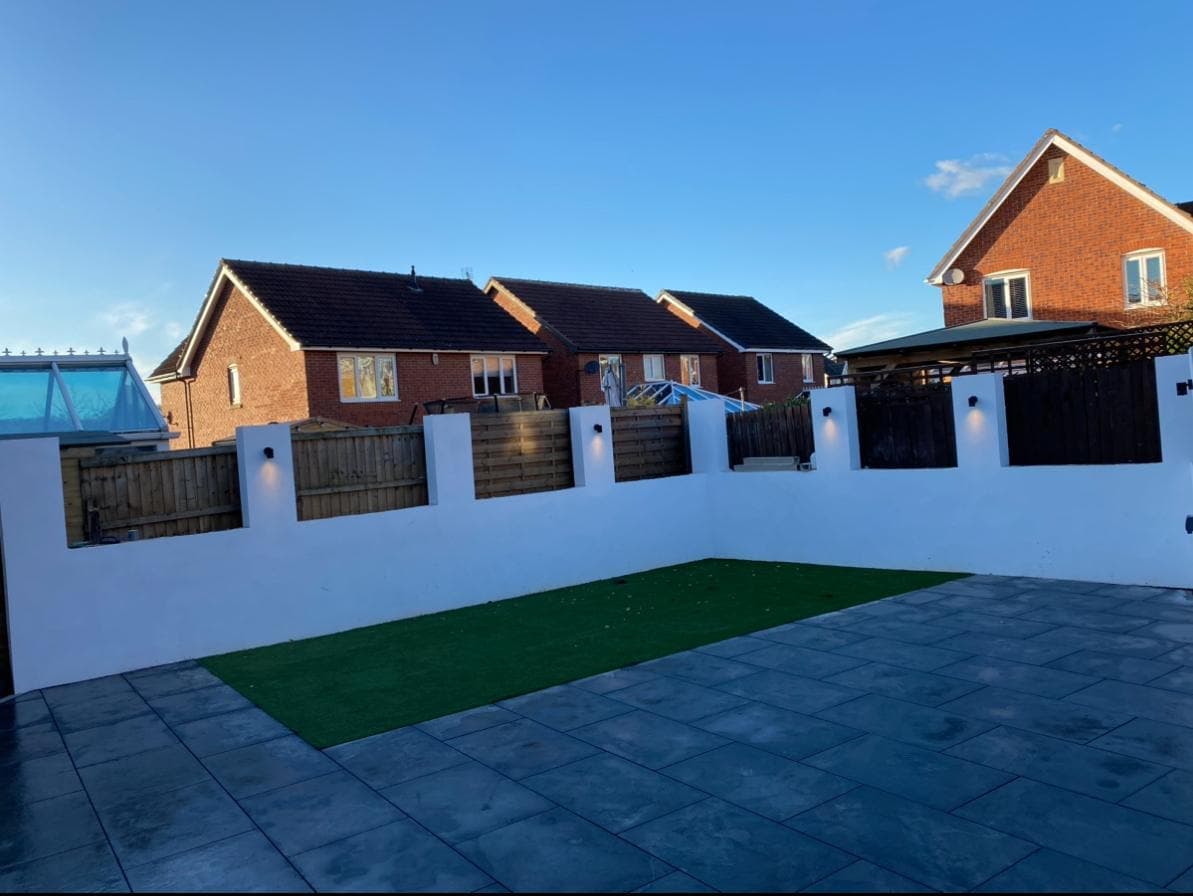
Finished rear garden with a grey porcelain patio, white rendered walls with wall lights and a rectangle of artificial grass

Garden landscaping

Garden landscaping in Barnsley, from the levels up

Our garden landscaping in Barnsley starts below the surface. We sort the levels and the drainage first, then build the walls, sleeper beds and fencing, then lay the patio, paths and the lawn, real turf or artificial. One firm for the whole garden. Ring Liam on 07709 099108 and he will come and look at the garden, free of charge.

What does garden landscaping in Barnsley actually involve?

Most of the money in a new garden goes into things you stop noticing once it is finished. A garden that slopes towards the house, a lawn that turns to mud every winter, a fence leaning because the posts were never set properly: none of those are fixed by new slabs and fresh turf. They are fixed by digging.

That is the part we are set up for, because groundwork is a big part of what we do, on drives, dropped kerbs and building sites. A landscaping job with us starts with where the ground sits and where the water goes, and finishes with the surfaces you see. Our reviews pick out our landscaping work by name, and the thing customers mention is Liam's advice on how the finished garden should look, not just a price to build it.

The patio meets the doors

  • Grey porcelain patio running along bifold doors, with a slot drainage channel at the threshold
    Drainage channel along the doors

How a garden is built, in order

  1. Clear and set the levels

    Old paving, roots and soil come out, and the new finished heights are set from the house, the doors and the boundaries. Everything after this depends on getting these right.

  2. Drainage

    Falls are set so surface water runs away from the house, and channels, gullies or soakaways go in where the ground cannot shed it on its own.

  3. Walls, retaining and edging

    Anything holding soil back is built next: block or brick walls, sleeper beds and kerb edges, on proper footings.

  4. Fencing

    Posts set in concrete, then the panels or boards. Doing it before the surfaces means nobody is mixing concrete on a new patio.

  5. Patio and paths

    Dug to depth, a compacted base, then the slabs bedded and pointed.

  6. The lawn

    Last of all, so it is not trampled. Topsoil raked level for real turf, or a compacted aggregate base and membrane for artificial grass.

Can a sloping garden be made level?

Yes, and on hilly ground like Barnsley’s, plenty of gardens need it. The usual answer is not one flat garden but two or three flat terraces, each held up by a retaining wall or a run of timber sleepers, with a step or a path between them. You end up with ground you can actually use, and somewhere for beds that does not wash down onto the lawn every time it rains.

Sleepers suit low changes in level and look right in most gardens. Where the drop is bigger, or the wall is holding up a drive or a neighbour's ground, it wants to be built in masonry, and as a rule of thumb a retaining wall holding back more than about a metre of soil should be designed by an engineer. Either way the wall needs drainage behind it, because wet soil pushes far harder than dry soil, and that is what tips old garden walls over.

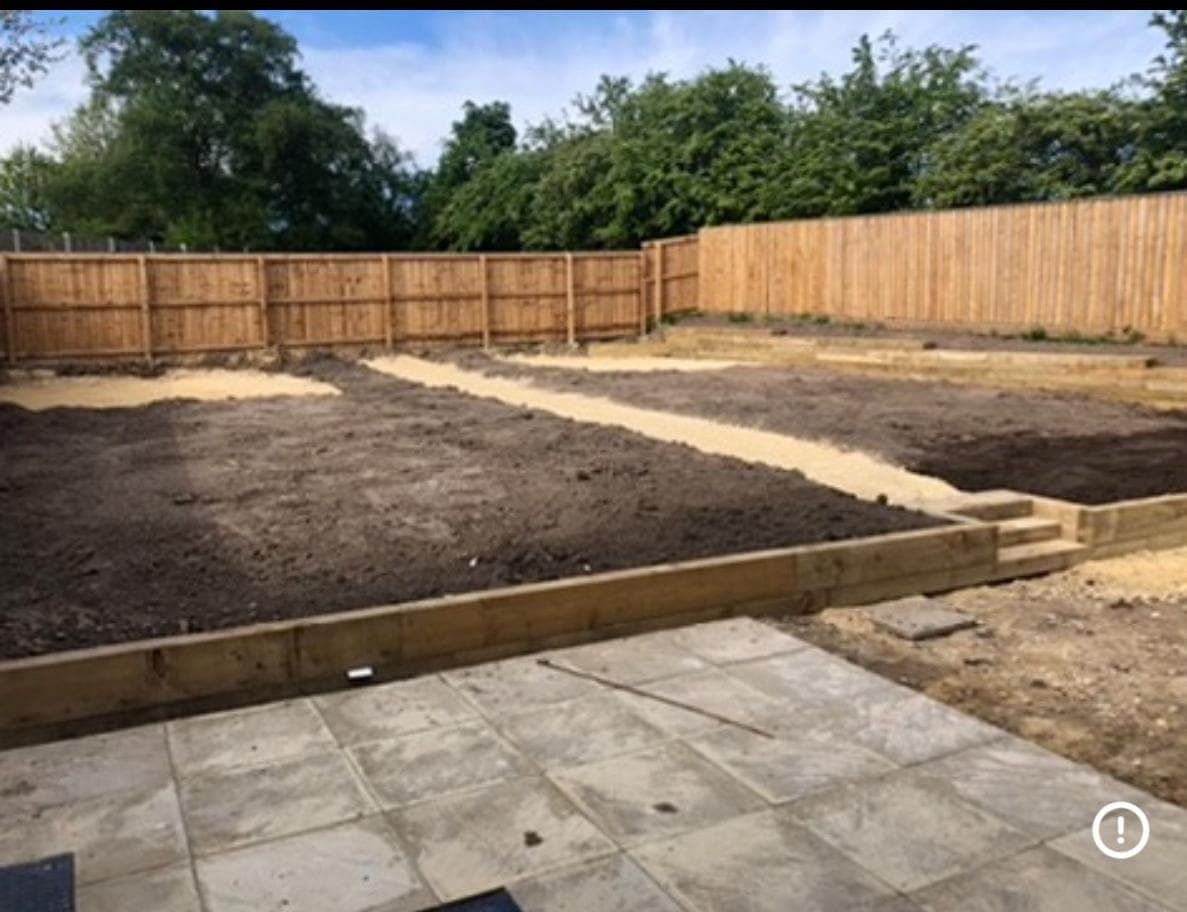
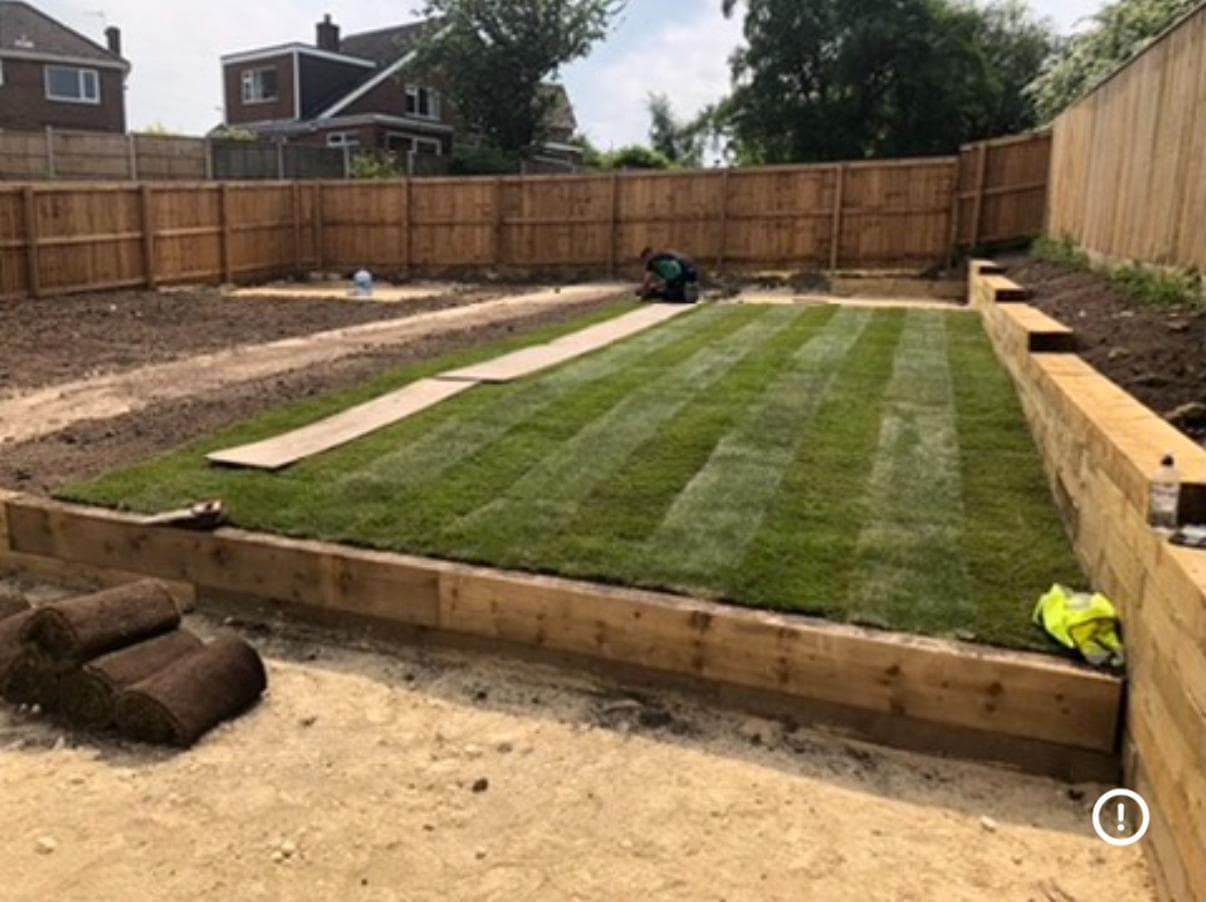
Levelled with sleepers, then turfed

  • Garden cleared and levelled behind new close board fencing, with timber sleeper beds, sand paths and a slab patio
    Levels, sleeper beds and paths set out
  • Fresh turf being laid between raised timber sleeper retaining beds, with rolls of turf still to go down
    Turf going down between the sleepers

A word on old railway sleepers

Reclaimed railway sleepers are usually treated with creosote, and the rules on creosote-treated wood say it should not be used in gardens where people will be touching it often, such as seating or beds you lean on to weed. Creosote can irritate skin and stains clothes in warm weather. New softwood or oak sleepers do the same job without the tar.

Real turf or artificial grass?

Real turfArtificial grass
Cheaper to lay. Most of the cost is the ground preparation, which both need.Costs more to lay, because it needs a dug out, compacted stone base under it.
Needs mowing, feeding and watering in dry spells.No mowing. Needs brushing, leaves cleared and the odd rinse.
Keep off it for a few weeks while the roots take.Usable the day it goes down.
Struggles in deep shade and on heavy, wet ground.Copes with shade, but it must drain or it puddles.
Stays cool in hot sun and feeds the wildlife.Gets hot in direct summer sun and gives nothing to insects or birds.

Why does drainage matter so much in a Barnsley garden?

Much of Barnsley sits on the Coal Measures, and in plenty of places that means clay subsoil: it holds water after rain and sets hard in a dry summer. Lay a lawn or a patio straight onto it and the water has nowhere to go. Artificial grass is the worst affected, because it only drains as well as the ground beneath it, which is why it should go onto a compacted stone base rather than onto soil.

The doors are the other place it matters. With bifolds and level thresholds, the patio often finishes almost flush with the door frame. A slot drain along the threshold, like the one in the photo near the top of this page, catches the water before it can sit against the frame.

Does a new garden wall or fence need planning permission?

Usually not. In England a fence, wall or gate is permitted development up to 2 metres high, but only up to 1 metre where it is next to a road used by vehicles, and that includes a front garden facing the pavement. The height is measured from the ground on your side, and trellis on top counts towards it. A listed building, or a home where the council has removed these rights, needs permission whatever the height.

A new wall built on the boundary line itself, rather than wholly on your land, also comes under the Party Wall etc. Act 1996, which means serving notice on the neighbour at least a month before the work starts.

Composite fencing on a corner plot

  • Bungalow on a corner plot with new grey composite fencing between concrete posts along the front boundary
    Grey composite boards, concrete posts
  • Grey composite fence running along the pavement side of a corner garden
    The pavement side

We put up composite fencing, which does not rot or need staining, and timber close board, which costs less and suits a back garden.

"Cleaned up after daily, worked hard in the heat, came daily from when I was promised."

Fencing, driveway and dropped kerb customer, Heckmondwike, on MyBuilder

Getting a garden landscaping quote in Barnsley

From our Barnsley base we take on gardens right across South and West Yorkshire. When the garden comes with a new drive at the front, our driveways and patios work covers that, and a dropped kerb can go in alongside it. Photos from other jobs are on our work page. For an estimate, which costs nothing, phone Liam on 07709 099108 or use the quote form at the bottom of this page.

Garden landscaping questions

  • When is the best time of year to lay new turf?

    Autumn and spring, when the ground is moist and warm enough for the roots to take without daily watering. It can go down in summer if you are prepared to water it every day for a couple of weeks. It should not be laid on frozen or waterlogged ground.

  • Can a garden be landscaped in winter?

    Much of it, yes. Clearing, digging, drainage and sleeper work carry on in most weather. Mortar and concrete are the exception: laying stops when it drops towards freezing, because frost damages them before they have set. Turf is best left until the ground is not frozen or sodden.

  • Is artificial grass all right for dogs?

    Yes, as long as it is laid on a free-draining base so urine runs through rather than sitting in it. Hose the area down regularly, and use a pet-safe enzyme cleaner in the spot the dog favours, to stop smells building up in warm weather.

  • Which way round should a new fence face?

    There is no law that says the good side has to face the neighbour, although that is the usual courtesy. What matters more is whose fence it is. Your title deeds sometimes mark which boundaries you are responsible for, and if they are silent, it is worth agreeing with the neighbour before the old one comes down.

Tell us what you are thinking of

It takes about a minute, and you do not need drawings or a budget worked out. We will come and look, and you will get a written price.

Free estimate, no obligation.

Finished rear garden with a porcelain patio and a new lawn